
Shared Custody Schedules That Actually Work
When parents share custody, the schedule matters just as much as the legal description. Even well-intentioned parents can struggle when a custody arrangement looks fair on paper but proves unworkable in real life. The most successful shared custody schedules are those that prioritize the child’s stability, accommodate the parents’ realities, and minimize conflict.
Below are some of the most effective shared custody schedules and the factors parents should consider when deciding what truly works.
Before discussing specific schedules, it’s important to understand the guiding principle: the best interests of the child. In determining the best interests of the child, courts consider factors such as:
- The child’s age and developmental needs
- Each parent’s work schedule and availability
- The distance between parents’ homes (and the distance between those homes and the child’s school)
- The child’s school and extracurricular activities
- Each parent’s ability to communicate and co-parent
- The historical caregiving roles of each parent
A schedule that works well for one family may be inappropriate for another.
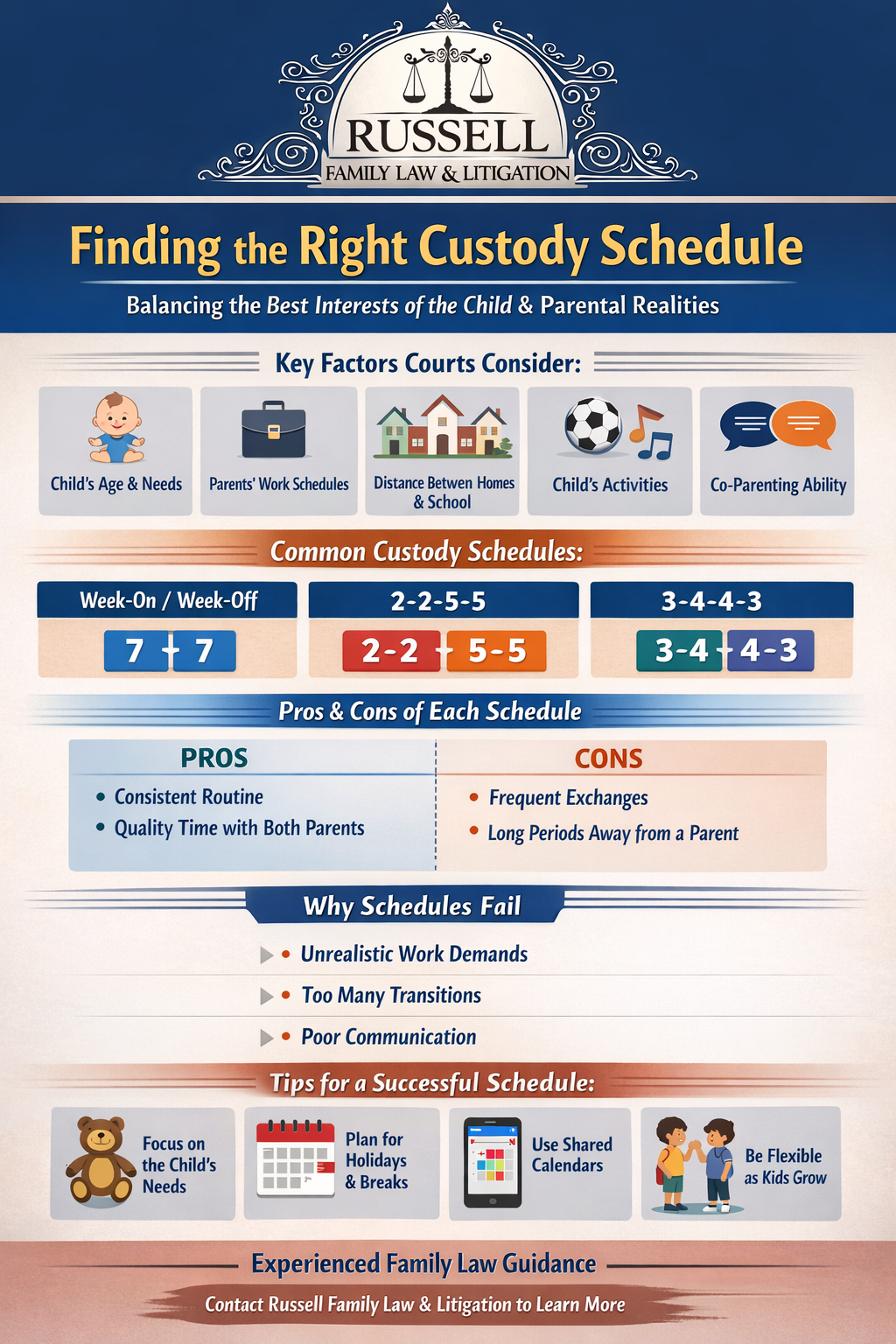
Some Pros & Cons of the Most Common Shared Custody Schedules
1. The Week-On / Week-Off Schedule
This schedule gives each parent a full week with the child, alternating weekly. It reduces transitions and allows each parent to manage school and activities independently during their parenting time.
Pros:
- Fewer exchanges
- Predictable routine
Cons:
- Long stretches away from one parent may be difficult for younger children
2. The 2-2-5-5 Schedule
Under this arrangement, the child spends two days with Parent A, two days with Parent B, and then alternates five-day blocks.
Pros:
- Regular contact with both parents
- Predictable school-week routine
Cons:
- More transitions
- Requires strong communication
3. The 3-4-4-3 Schedule
The child alternates three days with one parent, four with the other, and then switches the following week.
Pros:
- Balanced time
- No parent goes too long without seeing the child
Cons:
- Can be confusing without a clear calendar
- Frequent exchanges
Why Some Schedules Fail
Even a well-designed schedule can break down if it does not account for real-world factors. Common reasons shared custody arrangements fail include:
- Unrealistic work schedules
- Excessive transitions for young children
- Poor communication between parents
- Long travel times between homes
- Using the schedule to “keep score” rather than meet the child’s needs
Tips for Creating a Schedule That Works
- Focus on the child’s routine
- Be realistic about work hours and availability
- Plan for school breaks, holidays, and summers in advance
- Use shared calendars or parenting apps to reduce conflict
- Build in flexibility, especially as children grow older
There is no single “perfect” shared custody schedule. The best arrangements are child-centered, realistic, and designed to reduce conflict rather than create it. Working with an experienced family law attorney can help ensure your custody schedule is not only legally sound, but practical for daily life. If you have questions about shared custody or need help creating or modifying a parenting plan, contact our office to set up a consultation with a family law attorney to discuss options tailored to your family’s needs.
Share This Post